AI compliance training · education hello@rxldtraining.com · (470) 207-3594
AI-built compliance training · Education

Your state already told you to do this. We'll help you actually do it.

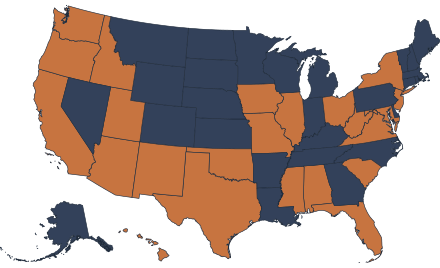
27 states have active AI-in-education legislation this year. 10 are already signed into law. Districts are being handed frameworks and guidance documents — but a policy PDF isn't training. We turn state guidance into a module your staff will actually complete.

AI-in-education legislation · 2026
Map of the United States with the states that have active AI-in-education legislation in 2026 shaded.
27 States with active
legislation this year
The pattern
we keep seeing

State departments of education are moving fast on AI policy — faster than most districts can translate that policy into actual staff training. A template or guidance document tells your district what to require. It doesn't tell your front-office staff, teachers, and administrators how to apply it in the moment a parent asks about a chatbot, or a teacher wonders if using AI to draft a family email crosses a line.

That gap — between policy and practice — is exactly where risk lives, and exactly where we build.

What's actually happening right now
  • 37 states plus Puerto Rico now have some form of official AI guidance or policy framework for K-12 education.
  • 27 states have active AI-in-education legislation in 2026; 10 are already signed into law.
  • Maryland now requires every district to name a central-office AI coordinator. Oklahoma requires a written district AI policy with parental transparency. South Carolina is considering requiring written parental opt-in consent for AI tool use.
  • At the federal level, a bill in Congress (the K–12 AI Literacy and Readiness Act) would allow federal education funds to be used specifically for AI curricula and staff training.

This isn't a future problem. It's a this-school-year problem.

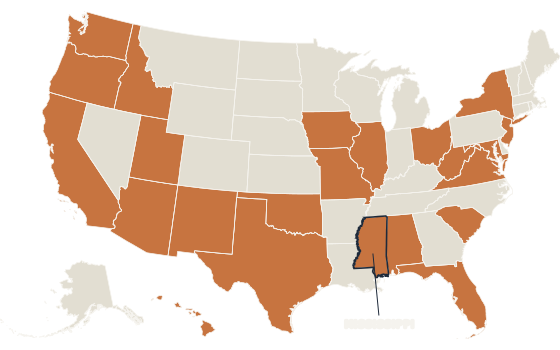
States with active AI-in-education bills · 2026Fig. 01
Map of the United States. The states with active AI-in-education legislation named in the 2026 FutureEd tracker are shaded; Mississippi is outlined as the page's case study.
27
States with active
AI-in-education legislation, 2026 session
Active 2026 legislation None tracked Case study
Source: FutureEd, “Legislative Tracker: 2026 State AI in Education Bills” — 77 bills across 27 states, updated 13 July 2026. Four of the 27 are not named individually in the tracker and so are not shaded. Bill status is not distinguished on the map.
Case study: Mississippi

A model worth following

Mississippi is further ahead than most states — and it shows exactly the gap districts are facing everywhere.

Policy timeline 03 STEPS TAKEN · 01 OUTSTANDING
2025

Statewide guidance

The Mississippi Department of Education issued statewide AI classroom guidance as early as 2025.

MDE · Classroom guidance
2026

Task force

SB 2429 established an AI in Education Task Force charged with developing guidelines for training K-12 educators to use AI tools responsibly.

SB 2429 · Educator training
Apr 2026

Governance template

The Mississippi Artificial Intelligence Network published a governance template for districts to adapt locally — a planning document, not a finished training program.

MAIN · District template
Not yet

Training delivery

A module staff sit through, understand, and can apply.

The gap we fill

Mississippi did the policy work. What's still missing in most districts — Mississippi included — is the actual training delivery: a real module staff sit through, understand, and can apply. That's the gap we fill.

Beyond the legislation

Your state doesn't need a law for this to matter.

Some states have passed sweeping AI-in-education legislation. Others have only issued guidance. Some haven't addressed it at all yet. The legislative picture will keep changing — but the underlying need doesn't wait for a bill number.

Across every state we've researched, the same six standards keep showing up, whether they're written into law or not:

01

Human review before AI output reaches a student or family

02

No high-stakes decisions made by AI alone

03

Transparency when AI is used

04

Data privacy and security

05

Only vetted tools

06

Knowing when to escalate rather than decide alone

Behind each of these is a literacy layer — the why, not just the rule — which is where the real training happens.

These aren't legal requirements in every state. They're what responsible use actually looks like — and legislation is still catching up to them, state by state. Staff readiness for AI shouldn't be contingent on which bill your legislature happened to pass this session.

AI literacy and appropriate use are not the same thing
Literacy

Understanding

Knowing what AI is, what it's good and bad at, and how to think critically about its output.

Asks: is this output any good?
Appropriate use

Conduct

The actual rules for what staff and students are permitted to do with it — and the consequences when they don't.

Asks: am I allowed to do this?

A staff member can understand AI well and still misuse it. A policy without literacy just produces confused compliance. Districts need both, paired — which is why we build both into one module, not two separate initiatives competing for the same training hour.

This isn't tool training

Free AI literacy resources exist — and they're worth using. But they teach staff how to use a specific tool. They aren't built around your state's specific guidance, your district's actual policy language, or the liability your compliance team is accountable for.

Free tool training

One size, every district

  • Teaches a specific tool
  • Same content for every district
  • No compliance mapping
  • No completion or audit trail
Answers: how does this tool work?
What we build

Mapped to your policy

  • Scenario-based, compliance-framed
  • Mapped to your state's framework
  • Built around your district's actual policy language
  • SCORM delivery in your existing LMS
Answers: are we doing what we're required to?

That's the gap between “training exists” and “training matches what we're legally required to do.” We build the second one.

The offer

What we build

01

Foundational AI Literacy & Appropriate Use Module

A scenario-based training module — built the same way as our mandated-reporter demo (Exhibit A) — covering both AI literacy and appropriate use for staff and students. Delivered as a SCORM package that runs inside your existing LMS, so your compliance team gets the same completion tracking and audit trail you already rely on for other required training.

02

District Customization

Every state's guidance is different. We adapt the module's scenarios, terminology, and standards references to match your state's specific framework — so staff are trained on your actual policy, not a generic one.

03

Professional Development Sessions Premium add-on

For districts who want more than a self-paced module, we offer live-facilitated PD sessions — a higher-touch layer on top of the core training, for kickoff sessions, administrator briefings, or deeper staff workshops.

Early adopter list

Be one of the first districts through the door.

This module is in active development. Districts who join the early adopter list get first access when it's ready, input into what the customization covers, and founding-district pricing that won't be offered again once the module ships broadly.

See a live preview of how this works →
First access when the module ships.
Thanks — you're on the early adopter list. We'll be in touch as the module takes shape.
Request intake

Tell us where your district stands.

15 minutes. No obligation — just a look at where your state's guidance is, and where your staff training isn't yet.

See it in practice →
hello@rxldtraining.com
(470) 207-3594
Reply within 1 business day.
Thanks — request received. We'll follow up within a business day.